
Slot Volatility Explained: Low, Medium and High Volatility Slots
Slot Volatility Explained: Low, Medium and High Volatility Slots
Slot volatility describes the general payout pattern associated with a slot game.
You may also see it referred to as variance.
Understanding volatility can help explain why two slot games with similar RTP percentages can produce very different patterns of results over shorter periods of play.
It does not predict whether you will win or lose during a particular session.
What Does Slot Volatility Mean?
Volatility describes the relationship between the general frequency and potential size of payouts in a slot's mathematical design.
Slots are commonly described as:
- Low volatility
- Medium volatility
- High volatility
These descriptions are general classifications rather than guarantees about what will happen during an individual session.
What Are Low Volatility Slots?
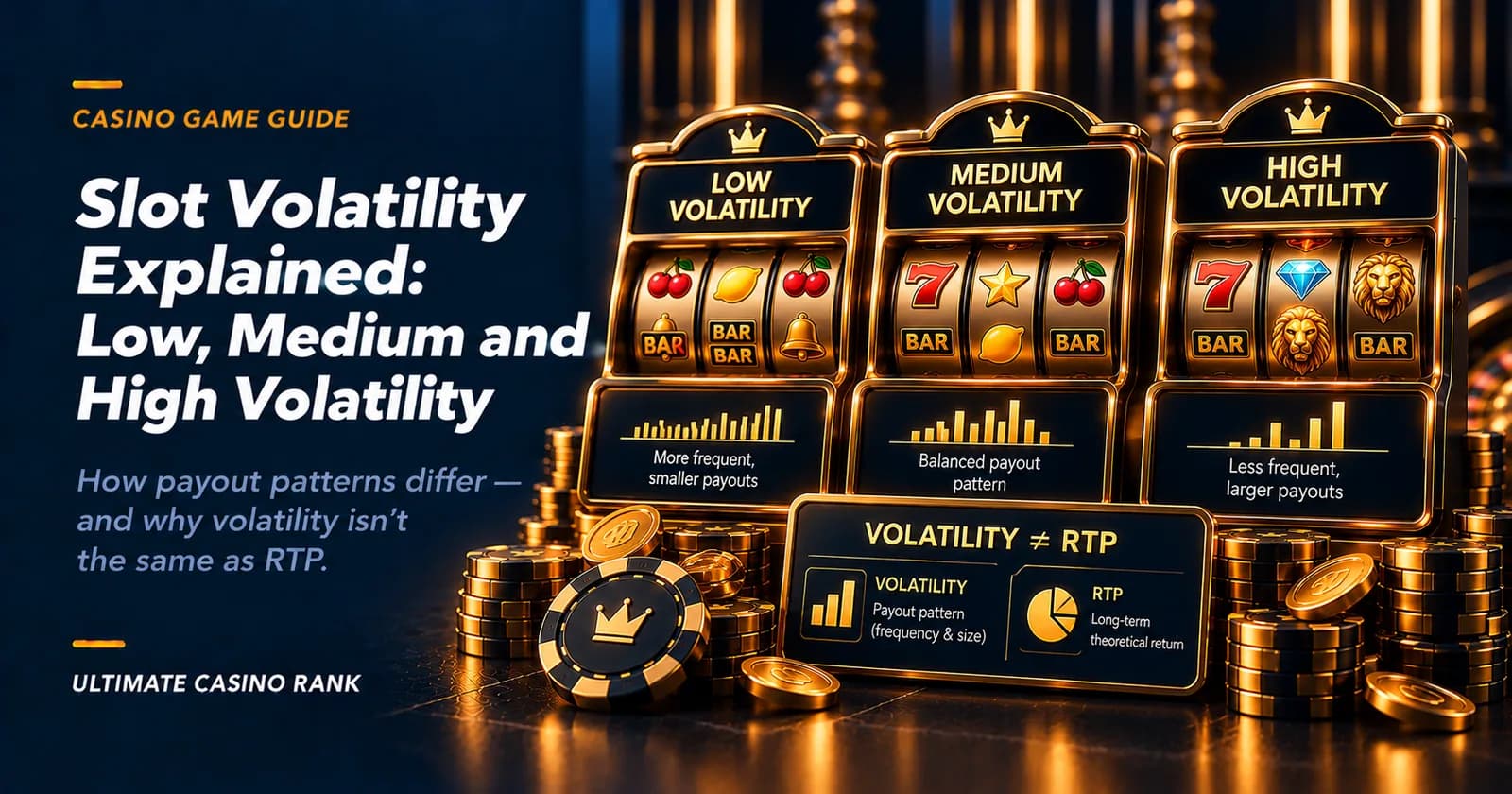
Low-volatility slots are generally designed around more frequent but typically smaller payouts compared with higher-volatility games.
This does not mean every session will produce frequent wins.
Random outcomes can still result in substantial short-term variation.
What Are Medium Volatility Slots?
Medium-volatility slots generally sit between low- and high-volatility games.
Their mathematical design may balance payout frequency and potential payout size differently from games at either end of the volatility range.
The exact characteristics depend on the individual game.
What Are High Volatility Slots?
High-volatility slots are generally associated with less frequent payouts and the potential for larger individual payouts compared with lower-volatility games.
However, a high-volatility classification does not mean a large win is guaranteed.
A player can experience extended periods without significant payouts.
Is Volatility the Same as RTP?
No.
RTP and volatility describe different aspects of a casino game.
RTP describes the theoretical percentage of wagers a game is designed to return over a very large number of plays.
Volatility describes the general distribution or pattern of those payouts.
Two games could therefore have similar theoretical RTP percentages while having very different volatility profiles.
Does High Volatility Mean Higher RTP?
No.
A high-volatility game does not automatically have a higher theoretical RTP.
Likewise, a low-volatility slot does not necessarily have a lower RTP.
The two measurements should be considered separately.
Does Volatility Affect the Chance of Winning?
Volatility helps describe a game's payout pattern rather than predicting the outcome of the next spin.
Casino game outcomes are uncertain, and volatility cannot tell you:
- Whether your next spin will win
- When a payout will occur
- How much you will win or lose during a session
- Whether a particular session will be profitable
Previous outcomes also do not guarantee future results.
How Can You Find a Slot's Volatility?
Some game providers or casinos display a volatility rating in the game's information.
It may be described using terms such as:
- Low
- Medium
- High
Some games may use numerical ratings or other scales instead.
If volatility information is not displayed, avoid assuming a classification based solely on recent results.
What Else Should You Check When Comparing Slots?
Volatility is only one characteristic of a slot.
Other information can include:
- Theoretical RTP
- Paytable
- Game rules
- Bet range
- Bonus features
- Paylines or other winning mechanics
- Jackpot structure, where applicable
If you are using a casino promotion, also check whether the game contributes towards wagering requirements.
Can Bonus Features Affect Volatility?
Bonus rounds, multipliers, jackpots and other game mechanics can form part of a slot's overall mathematical design.
These features may influence how payouts are distributed.
However, the precise effect depends on the individual game.
Which Volatility Level Is Best?
There is no single volatility level that is objectively best for every player.
The classifications describe different game characteristics rather than guaranteeing better results.
Understanding the distinction can simply help you interpret how a game is designed to behave over time.
Final Thoughts
Slot volatility describes the general pattern of payouts associated with a game.
Low-volatility slots are generally associated with more frequent, smaller payouts, while high-volatility games tend towards less frequent but potentially larger payouts.
Most importantly, volatility is not a prediction.
It should be understood alongside RTP, game rules and the other characteristics of the individual slot.